The exhibition in Arezzo dedicated to the Seraphic Father, Saint Francis titled "The Image of Francis: From the Middle Ages to the Twentieth Century" and held at the Gallery of Modern and Contemporary Art in Piazza San Francesco is exceptionally well-curated. The exhibition traces the profound evolution of the saint’s iconography over the centuries, moving from the symbolism of the Byzantine style to the more tangible, humanized depictions characteristic of the 16th and 17th centuries. Early symbolic portraits of the saint such as the magnificent work by Margarito d’Arezzo show him without the stigmata, in ascetic poses, and lacking a halo, dressed simply in a habit with a hood. With Giotto, the saint becomes more human, defined by concrete gestures, as can be seen in the Lower Basilica of Assisi. In that same work, Giotto highlights the enduring bond between the saint and the city of Arezzo, drawing inspiration from the *Legenda Maior* (Greater Legend) by Bonaventure of Bagnoregio: "When Blessed Francis saw demons exulting over the city of Arezzo, he said to his companion: 'Go, and in the name of God, drive out the demons just as the Lord Himself has commanded you by calling out from outside the city gate.' His companion obeyed, and as he cried out, the demons fled, and peace was immediately restored." It is worth noting that the most significant event in the saint’s life the receiving of the stigmata, which definitively elevated him to the status of *alter Christus* ("another Christ" took place within the territory of Arezzo, at La Verna. The exhibition features Fra Angelico’s depiction of "Saint Francis Receiving the Stigmata" (at La Verna), while Sandro Botticelli’s "Saint Francis with Angels" portrays the saint being comforted by the celestial music of a host of angels. The 16th and 17th centuries a period marked, above all, by the Counter-Reformation presented a Saint Francis immersed in solitude, absorbed in prayer before a crucifix or accompanied by a skull, a *memento mori*. In his *Saint Francis Adoring the Crucifix*, Annibale Carracci portrayed the saint in his rigorous poverty, clad in a rough, patched habit. Here, the saint invites us to contemplate a crucifix in which the Redeemer appears as flesh and blood dripping with blood, much like the saint of Assisi himself. Above, a rose plant devoid of blossoms evokes the Crown of Thorns worn by the Lord, while perhaps also alluding to the famous episode in which Francis, while living as a hermit, threw himself into a thicket of briars to resist the devil. In his *Saint Francis*, Federico Barocci frames the scene through a play of light and shadow; the cadaverous green of the crucified Christ rendered with striking vitality by the painter stands out, while the saint’s eyes, filled with a mystical intensity, appear languid with deep emotion. Also noteworthy is the modern interpretation of Saint Francis by Giò Ponti. Throughout history, as various religious orders vied with one another, they commissioned artists to create their own depictions of Saint Francis each intended to serve as a powerful symbol and a draw for the faithful within that particular order. In 2026, marking the eight-hundredth anniversary of the *Transitus* (passing) of Saint Francis, the city of Arezzo celebrates a saint whose life is deeply intertwined with its own soil. This splendid exhibition traces his representation from the late Byzantine period through the modern Western tradition, revealing how every era has discovered something unique in Saint Francis a different story to tell.
Valentina Niccolai










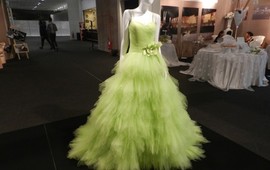
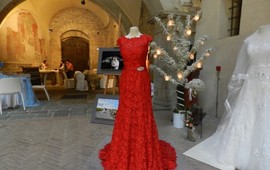


 Sartoria della Musica
 Online publication Registration Court of Siena n ° 1 of 28/01/2010 Publisher and Managing Director Valentina Niccolai.


